

FOR IMMEDIATE RELEASE - March 9, 2026
PRESS CONTACTS:
Media Relations - mediarelations@janm.org - 213.830.5690
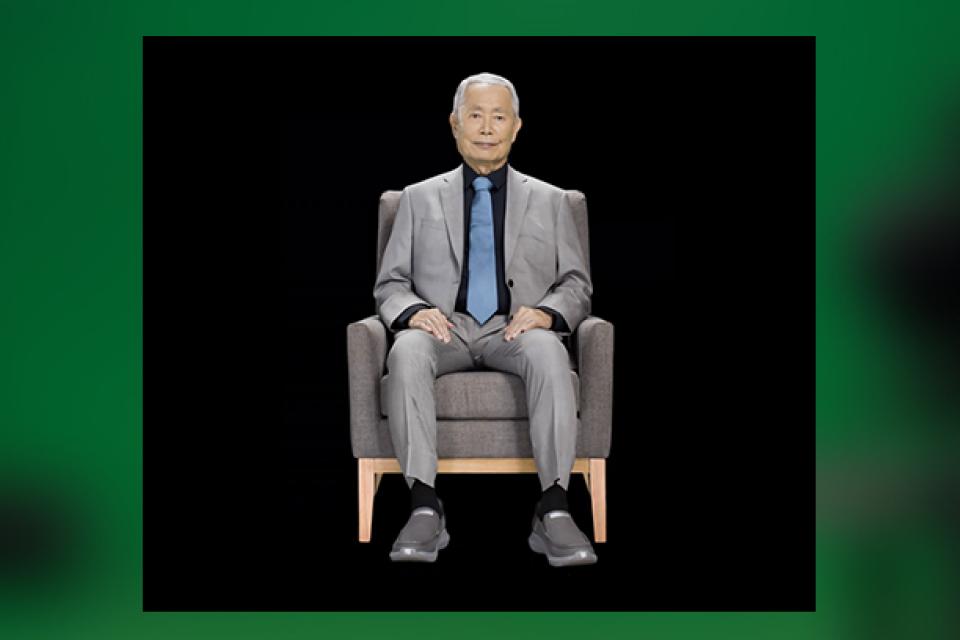
JANM to Preview Interactive StoryFiles of George Takei and Others March 21
Editors please note: JANM’s Pavilion is closed for renovation; programs will continue on the JANM campus and at other locations at janm.org/OnTheGo.
LOS ANGELES, CA – The Japanese American National Museum (JANM) will preview four new interactive StoryFiles—a groundbreaking storytelling technology—of actor, author, and activist George Takei and three other Japanese Americans who were incarcerated in America’s concentration camps during World War II: June Aochi Berk, Takashi Hoshizaki, and Mary Murakami. Based on hours of recorded interviews, StoryFiles use AI technology to give visitors a realistic experience of engaging with the subjects in conversation about their personal accounts of American history. The four new StoryFiles, along with the StoryFile of Lawson Ichiro Sakai, will be part of JANM’s newly renovated galleries when it reopens later this year. The public is invited to try out the new StoryFiles on Saturday, March 21, from 10 a.m. to 1 p.m. PDT, in JANM’s Democracy Lab. Tickets are available at janm.org/events.
“First person storytelling has always been an important part of JANM’s mission to share the lessons of history forward, and to connect past and present. We are so grateful to these individuals and their families who have devoted countless hours of their time and energy to ensure that their stories are preserved for generations to come,” said Ann Burroughs, JANM President and CEO. “The StoryFile of World War II veteran Lawson Sakai has been a very popular and moving experience for JANM visitors since 2021, and we are thrilled to add different perspectives on the Japanese American story—from forced removal and incarceration to draft resistance to LGBTQ+ activism—for our visitors.”
“Our mission is to ensure that the history of Japanese Americans during World War II remains visible in our nation’s public memory,” said Dana Heatherton, co-chair of the National Japanese American Memorial Foundation. “By using new AI technology to share these accounts, this initiative will make it possible for people anywhere in the world to engage with this history in a direct and meaningful way. As the number of people who lived through the wartime experiences of Japanese Americans grows smaller, it becomes increasingly important to document and share their experiences so that this chapter of American history cannot be erased or rewritten. We are grateful to JANM and to the individuals who contributed their stories to make this project possible.”
Educators will have the opportunity to learn how StoryFile can be used in their classrooms and discover new ways to engage K–12 students with American history by bringing first-person accounts of World War II history to life at a preview for teachers and educators at 9 a.m. on March 21.
Takei is an actor, social justice activist, social media mega-power, and New York Times bestselling author who was incarcerated in the Rohwer concentration camp and Tule Lake segregation center during World War II. He chronicled his experiences in his graphic memoir They Called Us Enemy and his children’s book My Lost Freedom. Berk is a dedicated JANM volunteer and the 1954 Nisei Week Queen who grew up in prewar Little Tokyo and was incarcerated at the Rohwer concentration camp. Her commitment to Japanese American cultural arts and social justice is reflected in her volunteer work at JANM and several other organizations including the Tuna Canyon Detention Station Legacy Project. Hoshizaki is a Heart Mountain resister and a board member of the Heart Mountain Wyoming Foundation. After being pardoned by President Truman in 1947, he earned his PhD in Botany from UCLA and had a distinguished career at the Jet Propulsion Laboratory. Murakami is a public health trailblazer and an advocate for equality who was incarcerated at the Topaz concentration camp in Utah during World War II. Today she shares her experiences to educate others about the injustices faced by Japanese Americans during the war. Each of them answered approximately 1,000 questions over several days to create a conversational experience for visitors interacting with their StoryFiles.
When JANM reopens in late 2026, the Museum’s renovated galleries will give visitors new ways to engage with American history. Five StoryFiles will be located in JANM’s new Hirasaki National Resource Center and Weingart Foundation Foyer, giving visitors a realistic experience of engaging with Japanese American concentration camp survivors and veterans and celebrating those who have ensured that their stories are preserved for generations to come.
The StoryFiles of Takashi Hoshizaki, Mary Murakami, and George Takei are presented by the Japanese American National Museum and the National Japanese American Memorial Foundation. The StoryFiles of June Aochi Berk and Lawson Ichiro Sakai are presented by JANM. The project was created with the nonprofit Japanese American Stories and is supported by The Freeman Foundation.
Additional support for the StoryFile of Takashi Hoshizaki comes from the Hoshizaki Family Endowment Fund. The StoryFiles of George Takei and June Aochi Berk are supported by Joanne Watanabe Erceg and in honor of Issei Pioneers: Bungoro & Fujino Morey, respectively.
###
About the Japanese American National Museum (JANM)
Established in 1985, JANM promotes understanding and appreciation of America’s ethnic and cultural diversity by sharing the Japanese American experience. Located in the historic Little Tokyo district of downtown Los Angeles, JANM is a center for civil rights, ensuring that the hard-fought lessons of the World War II incarceration are not forgotten. A Smithsonian Affiliate and one of America’s Cultural Treasures, JANM is a hybrid institution that straddles traditional museum categories. JANM is a center for the arts as well as history. It provides a voice for Japanese Americans and a forum that enables all people to explore their own heritage and culture. Since opening to the public in 1992, JANM has presented over one hundred exhibitions onsite while traveling forty exhibits to venues such as the Smithsonian Institution and the Ellis Island Museum in the United States, and to several leading cultural museums in Japan and South America. JANM’s Pavilion is closed for renovation; programs will continue on the JANM campus, throughout Little Tokyo, Los Angeles, and Southern California, and beyond from early January 2025 through late 2026. For more information, visit janm.org/OnTheGo or follow us on social media @jamuseum.
PRESS PHOTO GALLERY
Password Access Only. Contact mediarelations@janm.org for access.
StoryFile Press Gallery
View GalleryRelated Events
1/